Vista interna · maqueta estática · nada se guarda ni se envía

Revisión del número 2

Carola, cada nota muestra el resumen propuesto al lado del abstract de PubMed del que sale. Ninguna nota llega al correo sin tu decisión: el número se habilita para envío solo cuando decides las 5 y apruebas al menos una. Lo que marques como «Editar» vuelve al equipo con tu corrección.

Bloque sin PMID: sale de las fuentes legales y del Ministerio de Salud citadas al pie

Qué significa cada sello y cómo leer la etiqueta

Los sellos existen por la Ley 20.606, sobre composición nutricional de los alimentos y su publicidad [1]. Un producto lleva sello cuando se le agregó azúcar, sodio o grasa saturada y además supera el límite que fijó el Ministerio de Salud [2] [3].

Cada sello avisa de un exceso distinto. Estos son los límites, medidos por cada 100 g si es sólido o por cada 100 ml si es líquido [3]:

Cómo leerla en el súper: primero cuenta los sellos. Entre dos productos parecidos, el Ministerio de Salud recomienda preferir el que no tiene sellos o tiene menos [2].

Si quieres más detalle, da vuelta el envase: en la tabla de información nutricional, la columna «100 g» es la que se compara con los límites [3]. Así puedes comparar productos aunque vengan en envases de distinto tamaño [2].

Los sellos no prohíben comer nada: son una ayuda para comparar [2]. Los productos a granel, sin envase, no están obligados a llevar etiqueta nutricional [2].

Fuentes legales y del Ministerio de Salud

Cómo nació el sello · PMID 31286910 · Journal Article, Review

1. Por qué un octágono negro

Resumen propuesto

Antes de la ley, un equipo chileno probó 15 diseños de sello con mujeres y adolescentes de barrios de ingresos bajos y medios de Santiago. Un disco «pare» en blanco y negro funcionó mejor que el dibujo de una mano: se veía mejor y cambiaba más la intención de compra. Por razones legales, el texto «Exceso de» pasó a ser «Alto en».

Qué significa para ti. El sello se diseñó para entenderse de un vistazo, sin leer letra chica.

Estudio de desarrollo en etapas: revisión, grupos de conversación y encuestas · 15 diseños probados · Reyes M et al. BMC Public Health, 2019

Abstract original

Development of the Chilean front-of-package food warning label.

BACKGROUND: Front-of package (FoP) nutrition labels are an option to guide consumer's decision at the point of food purchase. Chile was the first country worldwide to implement a FoP warning label and thereafter several countries have followed this model. The objective of this study is to describe the process of development of the Chilean FoP warning label. METHODS: A stepwise study was conducted including literature review, qualitative phase (lay audience & expert group meetings) and quantitative phase in women/adolescents from low-middle-socioeconomic status neighborhoods, Santiago, Chile (2 sub-studies, using point-of-sale questionnaires). Outcomes were prototype visualization, ease of understanding, and ability to modify purchase behavior. RESULTS: The literature review and qualitative phase provided information on general text (e.g. short wording) and design characteristics (e.g. use of a logo, use of red or black colors); based on these characteristics 15 prototypes were created and quantitatively tested. In the first survey, a black-&-white stop sign and a black-&-white hand were preselected; in the second survey, the stop sign stating 'Excess of <nutrient>' had significantly better performance than the hand in terms of visualization, intention to purchase, and ability to modify intended purchase. Due to legal reasons the "excess of" was replaced by "high-in" in the final implementation of the law. CONCLUSIONS: A simple black-&-white stop sign warning label was the best option to flag pre-packaged foods with an excess of energy or nutrients of concern for non-communicable diseases; this FoP warning label was implemented in Chile in June 2016 as part of the Chilean Food Labeling and Marketing Law.
Decisión de Carola

Ley 20.606 y compras · PMID 39331649 · Journal Article, Research Support, Non-U.S. Gov't

2. Tres años después, los hogares compran menos azúcar y sodio de productos con sello

Resumen propuesto

Se siguieron las compras de 2.844 hogares chilenos entre 2013 y 2019. Comparado con lo que se esperaba sin la ley, en su segunda fase las compras de productos con sello bajaron 36,8 % en azúcar, 23,0 % en calorías, 21,9 % en sodio y 15,7 % en grasa saturada. Al mismo tiempo, subieron las compras de productos sin sello. El patrón fue parecido en hogares de menos y de más ingresos.

Qué significa para ti. La baja del azúcar vino sobre todo de las bebidas, y la del sodio y la grasa, de los alimentos. Es un estudio de compras, no de lo que comió cada persona.
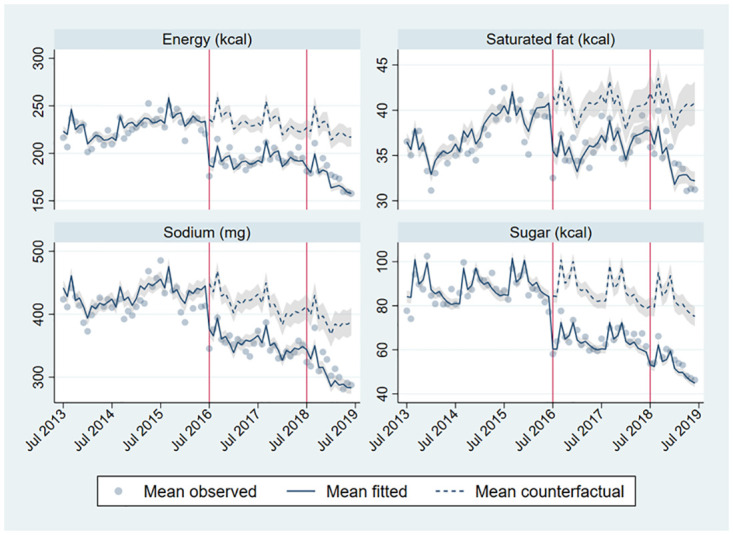
Cuatro gráficos de calorías, grasa saturada, sodio y azúcar comprados por persona al día entre 2013 y 2019: desde mediados de 2016 lo observado queda bajo la línea punteada de lo esperado sin la ley

Figura del estudio (en inglés). Puntos y línea continua: lo que se compró; línea punteada: lo que se esperaba sin la ley. Las líneas rojas marcan la entrada en vigor de la ley (2016) y su segunda fase (2018). Taillie y colaboradores, PLoS Medicine 2024, licencia Creative Commons Atribución 4.0.

Estudio de compras antes y después de la ley · 2.844 hogares · Taillie LS et al. PLoS Med, 2024

Abstract original

Decreases in purchases of energy, sodium, sugar, and saturated fat 3 years after implementation of the Chilean food labeling and marketing law: An interrupted time series analysis.

BACKGROUND: In 2016, Chile implemented a multiphase set of policies that mandated warning labels, restricted food marketing to children, and banned school sales of foods and beverages high in nutrients of concern ("high-in" foods). Chile's law, particularly the warning label component, set the precedent for a rapid global proliferation of similar policies. While our initial evaluation showed policy-linked decreases in purchases of high-in, a longer-term evaluation is needed, particularly as later phases of Chile's law included stricter nutrient thresholds and introduced a daytime ban on advertising of high-in foods for all audiences. The objective is to evaluate changes in purchases of energy, sugar, sodium, and saturated fat purchased after Phase 2 implementation of the Chilean policies. METHODS AND FINDINGS: This interrupted time series study used longitudinal data on monthly food and beverage purchases from 2,844 Chilean households (138,391 household-months) from July 1, 2013 until June 25, 2019. Nutrition facts panel data from food and beverage packages were linked at the product level and reviewed by nutritionists. Products were considered "high-in" if they contained added sugar, sodium, or saturated fat and exceeded nutrient or calorie thresholds. Using correlated random-effects models and an interrupted time series design, we estimated the nutrient content of food and beverage purchases associated with Phase 1 and Phase 2 compared to a counterfactual scenario based on trends during a 36-month pre-policy timeframe. Compared to the counterfactual, we observed significant decreases in high-in purchases of foods and beverages during Phase 2, including a relative 36.8% reduction in sugar (-30.4 calories/capita/day, 95% CI -34.5, -26.3), a 23.0% relative reduction in energy (-51.6 calories/capita/day, 95% CI -60.7, -42.6), a 21.9% relative reduction in sodium (-85.8 mg/capita/day, 95% CI -105.0, -66.7), and a 15.7% relative reduction in saturated fat (-6.4 calories/capita/day, 95% CI -8.4, -4.3), while purchases of not-high-in foods and drinks increased. Reductions in sugar and energy purchases were driven by beverage purchases, whereas reductions in sodium and saturated fat were driven by foods. Compared to the counterfactual, changes in both high-in purchases and not high-in purchases observed in Phase 2 tended to be larger than changes observed in Phase 1. The pattern of changes in purchases was similar for households of lower versus higher socioeconomic status. A limitation of this study is that some results were sensitive to the use of shorter pre-policy time frames. CONCLUSIONS: Compared to a counterfactual based on a 36-month pre-policy timeframe, Chilean policies on food labeling, marketing, and school food sales led to declines in nutrients of concern during Phase 2 of implementation, particularly from foods and drinks high in nutrients of concern. These declines were sustained or even increased over phases of policy implementation.
Decisión de Carola

Reformulación · PMID 37299593 · Systematic Review

3. Los sellos también cambian lo que hay dentro del envase

Resumen propuesto

Esta revisión reunió 39 estudios sobre qué hace la industria cuando aparece un etiquetado en el frente del envase. Las etiquetas fáciles de entender empujaron a cambiar recetas, sobre todo para bajar sodio, azúcar y calorías. Cuando el etiquetado fue obligatorio, el efecto fue mayor y más parejo que cuando fue voluntario.

Qué significa para ti. Un producto sin sello hoy puede haber cambiado su receta. Mirar la etiqueta de vez en cuando sirve, aunque compres siempre lo mismo.

Revisión sistemática · 39 estudios · Ganderats-Fuentes M et al. Nutrients, 2023

Abstract original

Front-of-Package Nutrition Labeling and Its Impact on Food Industry Practices: A Systematic Review of the Evidence.

The obesity epidemic has become a major public health concern globally, and the food supply is a significant driver of this trend. Front-of-package (FOP) labels have been implemented in many countries to encourage healthier food choices. This systematic review aimed to examine the effect of FOP label implementation on food manufacturers' practices. A comprehensive search of multiple databases was conducted following PRISMA guidelines, identifying 39 relevant articles from 1990 to 2021. The studies indicated that FOP labels conveying intuitive information influenced product reformulation, whereas those with numerical information without specific guidance had no impact on reducing unhealthy nutrients. The most common outcomes were sodium, sugar, and calorie reduction. Mandatory policies reported higher and more consistent effects on product reformulation compared to voluntary approaches. Voluntary FOP labeling resulted in low uptake and tended to be applied to healthier products. Food manufacturers responded to FOP labeling heterogeneously, depending on the label design and type of enforcement. FOP label implementation can reduce nutrients of concern but food manufacturers behave strategically by labeling healthier choices. This review provides recommendations for maximizing the benefits of using FOP labels to prevent obesity, and findings can inform future public health research and policymaking.
Decisión de Carola

Ley 20.606 y precios · PMID 37400119 · Journal Article, Research Support, Non-U.S. Gov't

4. ¿Subieron los precios con la ley?

Resumen propuesto

Con datos de compras de hogares chilenos entre 2014 y 2017, este estudio comparó los precios de productos con sello, sin sello y con receta cambiada contra un grupo de control. Los precios no cambiaron por la ley, tampoco para hogares de distintos niveles de ingreso.

Qué significa para ti. En el primer año y medio de la ley, cambiar recetas no encareció los productos. El estudio no mira lo que pasó después.

Estudio de precios antes y después de la ley · Precios de 2014 a 2017 · Paraje G et al. BMJ Glob Health, 2023

Abstract original

Evolution of food and beverage prices after the front-of-package labelling regulations in Chile.

INTRODUCTION: This study assesses the impact on prices of the 2016 Chilean comprehensive food policy package, centred around front-of-package warning labels for food and beverages high in saturated fats, sugars, calories and/or salt, on food and beverage prices, labelled or not. METHODS: Data from Kantar WorldPanel Chile, from January 2014 to December 2017, were used. The methodology implemented was interrupted time series analyses with a control group on Laspeyres Price Indices on labelled food and beverage products. RESULTS: After the regulations were implemented, prices among different categories of products (eg, high-in; reformulated but still high-in; reformulated and not high-in; not high-in) did not change with regulations relative to the control group. Specific price indices (relative to the control group) for households from different socioeconomic strata remained unchanged. CONCLUSIONS: Even where reformulation was extensive, we found no evidence that it was associated with price changes, at least during Chile's first year and a half of regulation implementation.
Decisión de Carola

Etiquetas en el mundo · PMID 33517247 · Systematic Review

5. Fuera de Chile, la evidencia es mixta

Resumen propuesto

Una revisión de 15 estudios sobre etiquetas en el frente del envase y compras encontró resultados mixtos según el tipo de etiqueta. De los dos estudios con advertencias de salud, uno mostró compras más saludables. Los autores concluyen que la evidencia todavía no es concluyente.

Qué significa para ti. En el mundo hay muchos tipos de etiqueta y no todos funcionan igual. Lo que pasó con los sellos chilenos se mide en los estudios de arriba.

Revisión sistemática · 15 estudios, 10 de ellos ensayos aleatorizados · An R et al. Public Health, 2021

Abstract original

Effect of front-of-package nutrition labeling on food purchases: a systematic review.

OBJECTIVES: This study systematically reviewed evidence from interventions on the effect of front-of-package (FOP) nutrition labeling on food purchases. STUDY DESIGN: The study design used in this study is a systematic review. METHODS: Keyword search was performed in PubMed, Web of Science, Scopus, and Cochrane Library. RESULTS: Fifteen studies (10 randomized controlled trials, four pre-post studies, and one case-control study) met the eligibility criteria and were included in the review. Five studies were conducted in a controlled setting through the establishment of an online virtual supermarket or physical laboratory food store solely for the intervention. In contrast, the remaining ten studies were conducted in a naturalistic setting where people commonly purchase foods (e.g., supermarket, grocery store, school/hospital cafeteria, or vending machine). FOP labels assessed included traffic lights, health star rating, daily intake guides, health warnings, and high sugar symbol labels. Compared with the control, FOP labels were effective for helping participants make healthier food purchase decisions in five of the 12 studies that assessed traffic lights labels, in one of the two studies that assessed health warning labels, and in one study that assessed high sugar symbol labels. Three assessed health star ratings and one assessed daily intake guide labels, but none revealed an effect on food purchases compared with the control. CONCLUSIONS: Findings on the effectiveness of FOP nutrition labels in 'nudging' consumers toward healthier food purchases remain mixed and inconclusive. Future studies should examine other types of FOP labels beside the traffic lights labels and explore the different effects by consumer affordability, population subgroup, and shopping environment.
Decisión de Carola